
How to Check if ChatGPT Recommends Your Products- A Free 10-Minute Test for Shopify Merchants
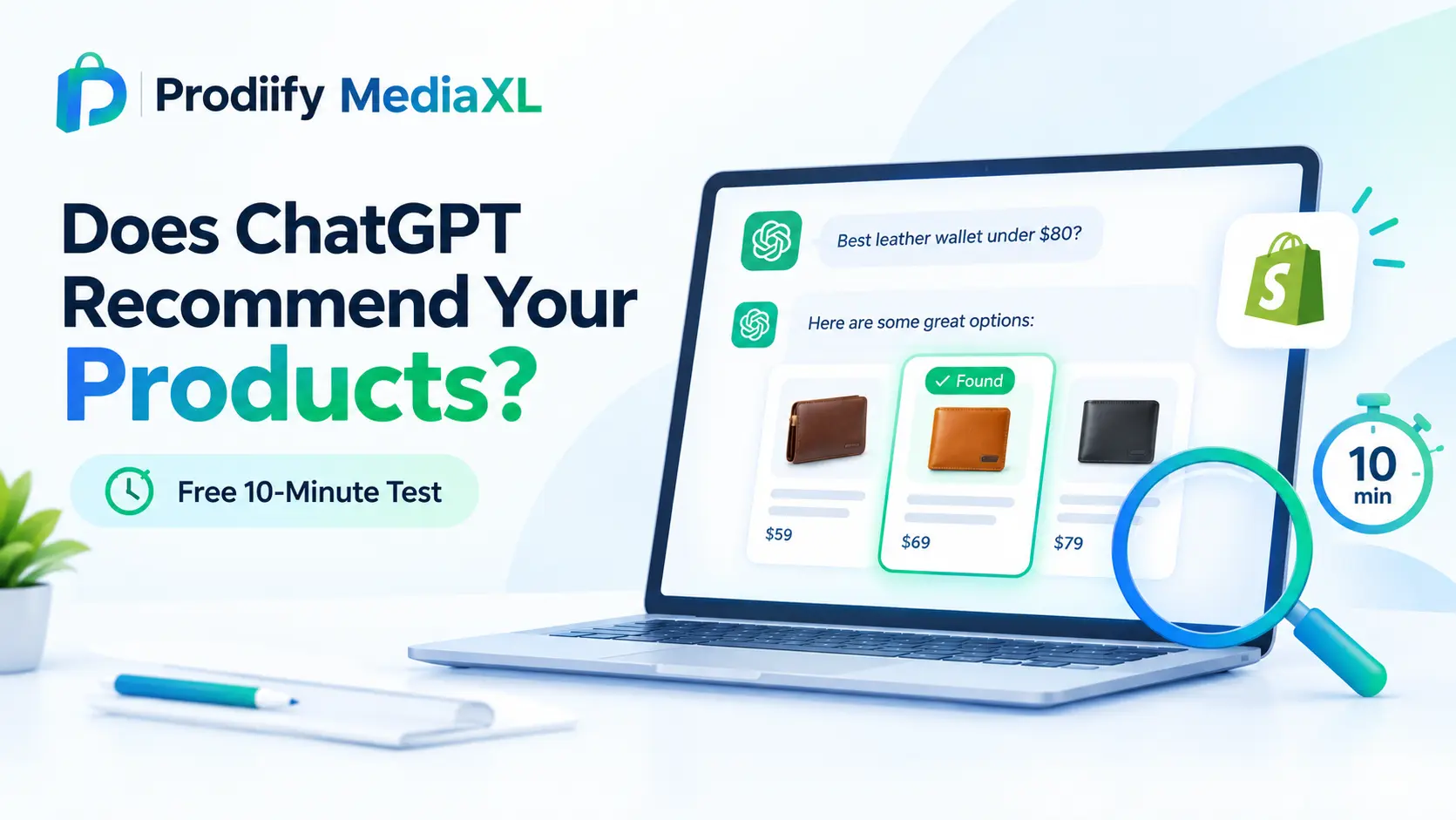
How to check if ChatGPT recommends your products, how to read the results honestly, and what to fix if your store is missing from the answer.
Shoppers are asking ChatGPT questions like “best handmade leather wallet under $80” and acting on the short list that comes back. If your store is not in that list, you will probably never know it happened.
The good news is that you can check, for free, in about ten minutes. This guide shows you how to check if ChatGPT recommends your products, how to score what you find, and why a single result should never be treated as a verdict.
Why This Test Is Worth Running
AI-driven shopping traffic is no longer a rounding error. On Shopify’s Q1 2026 earnings call, the company said AI-driven traffic to its stores grew 8x year over year, while orders from AI-powered searches rose nearly 13x. For more background, read our guide to Shopify agentic commerce.
A quick test will not give you a ranking. It will give you a snapshot of how your category looks from a shopper’s side, and a list of things to improve.
What This Test Is (and Is Not)
Be clear about the limits before you start:
- It is not a ranking. One tracking guide stresses that ChatGPT recommendations are not a single rank you can check once.
- Answers vary. One guide on DIY checks notes that answers vary 99 times out of 100. Run several prompts and look at patterns, not one response.
- It is a signal, not a diagnosis. Missing from an answer can have several causes, including how an answer was phrased, personalization, and how much other trusted sources say about your brand.
Before You Start- Set Up a Fair Test
Most people run this test the wrong way. Avoid these mistakes:
- Do not type your brand name. One guide points out that checking your own brand name is not the same as checking whether ChatGPT recommends you. A real shopper does not know your name yet.
- Use a fresh or logged-out session. In your normal account, ChatGPT may draw on memory of your past chats, which skews results compared with what a stranger sees. If you use a paid account, turn memory off or use a temporary chat.
- Use specific prompts. A tracking guide calls “best running shoes” a weak test, because the audience and use case are unclear. Include a need, a constraint and a product category.
- Test your own market. If you sell in more than one country, test each separately.
Run the Test: How to Check if ChatGPT Recommends Your Products
Open a fresh session and run these prompts, replacing the brackets with your own details. Use the formula “best [product type] for [customer or situation]”, then add a constraint like price, material or occasion.
Discovery prompts (no brand name):
- Best [product type] for [customer]
- Best [product type] under [price]
- [Product type] for [specific use case]
- Gift ideas for [person] who likes [interest], under [price]
Comparison prompts:
5. What should I look for when buying [product type]?
6. Alternatives to [well-known competitor] for [use case]
7. [Material or feature] [product type]: what are the best options?
Detail prompts:
8. Which [product type] is best for [specific problem]?
9. [Product type] that ships to [your country] and is made from [material]
10. Where can I buy [niche product type] online?
Example for a leather goods store: “Best handmade leather wallet under $80”, “Slim leather wallet for travel”, “Gift for a dad who likes quality leather goods.”
How to Score Your Results
Log each answer in a simple sheet. A visibility guide suggests tracking a mention rate, meaning the share of prompts where your brand appears anywhere in the answer, and a recommendation rate, meaning the share where your brand is positioned as a suggested option. marketerhire
| Prompt | Mentioned? | Recommended? | Who appeared instead? | Sources cited | Date |
|---|---|---|---|---|---|
| Best handmade leather wallet under $80 | Yes / No | Yes / No |
Then calculate:
- Mention rate = prompts where you appear ÷ total prompts
- Recommendation rate = prompts where you are recommended ÷ total prompts
Repeat the test every few weeks. One guide considers a quarterly check fine for most businesses, but if you are actively improving your listings, checking monthly shows whether your changes are working.
How to Read the Results
| What you see | What it may mean | Where to start |
|---|---|---|
| You never appear | Your products may be hard for AI to understand or find | Product data and descriptions |
| You appear for some prompts but not others | Gaps in specific attributes, such as material or use case | Detail and attribute coverage |
| Competitors appear with sources cited | Others have more supporting content or mentions | Content and external mentions |
| You appear, but details are wrong | Outdated or unclear information about your products | Accuracy and consistency |
One more insight from the research: AI tends to recommend what other trusted sources recommend, which is often why competitors show up. So the fix is rarely only about your own product pages. Reviews, mentions and clear product information all play a part.
Coredna’s product retrieval test frames the core question well: whether the facts about your products can be reached by the system assembling the answer. That is a data question, and a data question can be fixed.
What to Fix if Your Store Is Missing
You do not need a rebuild. Work through this list, starting with your best sellers.
1. Make Your Product Data Clear and Complete
Say what the product is, who it is for, what it is made of, what sizes it comes in and how it is used. Our guide to enhanced product descriptions on Shopify shows the format. To draft faster, use an AI product description generator for Shopify, a Shopify product description generator or these ChatGPT prompts for Shopify product descriptions.
2. Replace Keyword Repetition With Specifics
Repeating the same phrase adds no new information. Read our guide on keyword stuffing on Shopify to see what to write instead.
3. Cover the SEO Basics
Titles, meta content and a healthy site help every channel. Work through our Shopify SEO checklist, these Shopify SEO tips and the Shopify technical SEO checklist.
4. Go Deeper on AI Search
Once the basics are in place, read our guides to Shopify AI search optimization for ChatGPT and how to get your Shopify products in ChatGPT.
5. Make the Page Convince Once They Arrive
Being mentioned is only half the job. The page still has to close the sale. See our guide to Shopify product page design. If you sell on marketplaces too, Shopify vs Amazon product pages shows where the gap tends to appear. To understand the idea behind richer pages, read about A+ Content for Shopify or compare options in our Amazon A+ Content alternative for Shopify breakdown.
Fix It Across Your Whole Catalog
Fixing five listings by hand is simple. Fixing five hundred is where most stores stall.
Prodiify is built for that. The AI SEO app for Shopify stores improves titles, descriptions and meta content in bulk, so more of your catalog is clear and complete. Prodiify MediaXL then adds drag-and-drop blocks (Banner/Hero, Image + Text, Feature List, Gallery, Video and Carousel) to your product pages, with no theme edits and no code.
Your 10-Minute Plan
- Open a fresh or logged-out ChatGPT session.
- Run five to ten category prompts without your brand name.
- Log whether you are mentioned, who appears instead and which sources are cited.
- Pick your top three products and improve their titles, descriptions and details.
- Run the same prompts again in a few weeks and compare.
FAQs
1.How do I check if ChatGPT recommends my products?
Open a fresh or logged-out ChatGPT session and ask the questions your customers would ask, such as “best [product type] for [customer]”, without typing your brand name. Record whether your store is mentioned, who appears instead and which sources are cited.
2.Why should I avoid using my brand name in the test?
Shoppers who do not know you yet will not type your name. Prompts that describe a need and a category show whether you enter consideration.
3.Is one ChatGPT answer enough to judge my visibility?
No. Answers vary between sessions and users. Run several prompts, repeat the test over time and look at patterns.
4.What if ChatGPT does not mention my store?
Treat it as a signal, not a verdict. Check whether your product data is clear and complete, whether you have supporting reviews or mentions elsewhere, and whether your pages are easy for AI tools to understand.
5.Can I guarantee ChatGPT will recommend my products?
No. Platforms apply their own ranking logic, and no one can promise a recommendation. Clear, accurate product information improves your chances of being understood and considered.
Conclusion: How to Check if ChatGPT Recommends Your Products, and What to Do Next
Running this test takes ten minutes and costs nothing. The result will not be a ranking, but it will show you how your category looks from a shopper’s side and where your product information falls short. Fix the gaps on your best sellers first, then test again and compare.
Try Prodiify free on the Shopify App Store and make your listings clear and complete across your catalog.