
Keyword Stuffing on Shopify- Why Clear Data Wins in AI Search
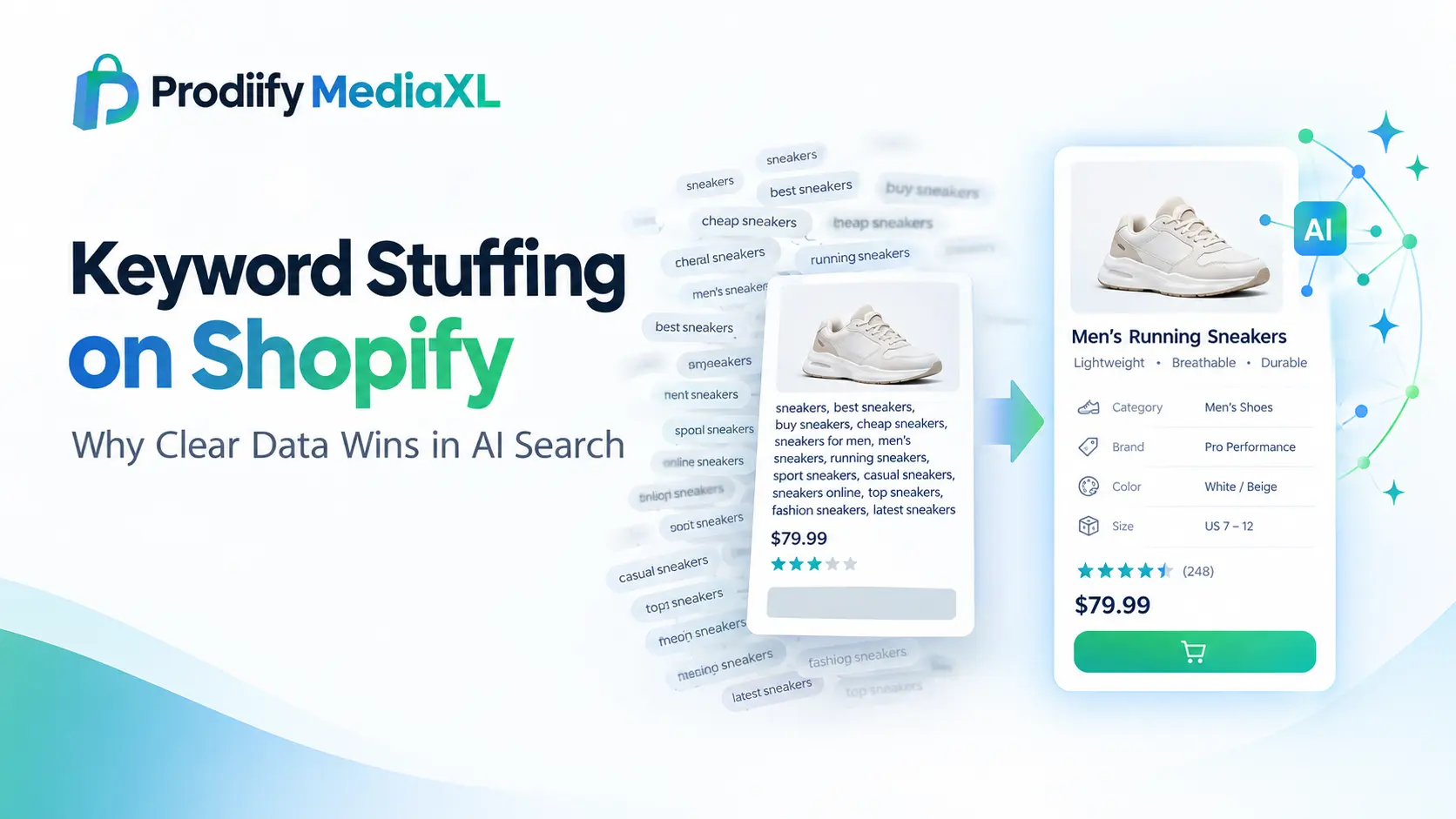
Keyword stuffing on Shopify was never a smart move, and AI shopping tools make it worse. Here is what to write instead.
There is a stubborn idea in ecommerce SEO: if search is changing, the safe move is to add more keywords. More phrases in the title, more variations in the description, more terms in the tags.
It is understandable. Keywords are the part of SEO people can see and count. But AI shopping assistants do not work like a keyword counter. They are trying to answer a specific question from a specific person, such as “a lightweight carry-on for weekend trips” or “a gift for a coffee lover under $50”. To match a product to that question, they need to understand the product. That is why keyword stuffing on Shopify now backfires: the goal is no longer to repeat what shoppers type, but to make what you sell clear, specific and complete.
Myth vs Fact
| Claim | Reality |
|---|---|
| Myth | AI search means adding more keywords to every listing. |
| Fact | AI search works better when your product data is clear, specific and structured. |
The rest of this guide explains why, shows what stuffing looks like inside a Shopify store, and gives you a simple way to replace it.
Why Stuffing Was Never a Good Idea
Google’s spam policies define keyword stuffing as filling a web page with keywords or numbers in an attempt to manipulate rankings in Google Search results. The same policies state that sites that violate them may rank lower in results or not appear at all. According to Ahrefs, most keyword stuffing is handled algorithmically rather than through manual actions, which means a store can lose ground quietly, with no warning email. Spam policies for Google web search +2
It also fails the human test. A description that repeats the same phrase five times tells a shopper nothing about size, material or fit. A page that does not answer questions does not convert, however well it is “optimized”.
Where Stuffing Hides in a Shopify Store
Most merchants do not set out to stuff keywords. It creeps in through habit. Check these places:
- Product titles that read like a list of search terms
- Descriptions that repeat the product name or category in every sentence
- Tags filled with near-duplicate variations
- Image alt text used as a place to dump keywords. One keyword guide gives the example of alt text filled with a keyword list, which violates accessibility standards and spam policies. seonio
- Meta titles and descriptions packed with phrases instead of a clear promise
- Collection descriptions and footer text written for search engines rather than shoppers
What AI Shopping Tools Actually Work From
When AI platforms surface products from Shopify stores, they rely on structured product information. Coverage of Shopify’s setup describes the catalog as supplying product titles, descriptions, images, variants, pricing and availability in a format those services can read. The same source adds that AI agents cannot fill gaps that a merchant leaves in the catalog.
Repetition adds no new information, so it cannot fill a gap. A clear detail can: “fits most standard cup holders” or “made from food-grade stainless steel” answers a real question.
Data quality also seems to matter for results. On Shopify’s Q1 2026 earnings call, the CFO said that traffic from catalog-powered AI searches converts about 2x better than traffic from general AI searches using scraped or outdated information. For the bigger picture, read our guide to Shopify agentic commerce.
One honest limit: platforms apply their own ranking logic, so no one can promise a recommendation. What you control is whether your data gives the system a good reason to include you.
Before and After, Field by Field
Here is an example with an imaginary product.
| Field | Stuffed | Clear |
|---|---|---|
| Title | Water Bottle Insulated Water Bottle Stainless Steel Water Bottle Gym | 500 ml Insulated Stainless Steel Water Bottle for Commuting and Gym |
| Description | Best water bottle, cheap water bottle, buy water bottle online. Great water bottle for water. | Keeps drinks cold for hours or hot for several. Food-grade stainless steel, leak-resistant lid, fits most standard cup holders. Hand wash recommended. |
| Tags | water bottle, bottles, best water bottle, water bottles | insulated, stainless steel, 500 ml, commuter, gym |
| Alt text | water bottle cheap water bottle best water bottle | Steel water bottle in matte black standing in a car cup holder |
| Meta description | Buy water bottle, best water bottle, cheap water bottle online | Insulated 500 ml steel bottle that fits cup holders. Cold for hours, three colors, free returns. |
(Replace “free returns” with your real policy before using this.)
The clear versions repeat nothing and say far more: what it is, who it is for, size, material and how it is used.
The Product Data Template
Use this structure for every product. It covers the questions shoppers and AI assistants most often need answered.
| Field | What to include | Example |
|---|---|---|
| What it is | Product type and defining attribute | Insulated stainless steel water bottle |
| Who it is for | The audience or situation | Commuters and gym-goers |
| Materials | What it is made of | Food-grade stainless steel |
| Sizes and dimensions | Exact options | 500 ml; fits standard cup holders |
| Variants | Every option, named clearly | Three colors, named plainly |
| Use cases | When and how it is used | Daily commute, workouts, day trips |
| Care and specs | Practical details | Hand wash recommended |
| Policies | Shipping and returns | Clear and easy to find |
How to Replace Keyword Stuffing on Shopify Step by Step
Replacing keyword stuffing on Shopify does not mean touching your whole catalog at once. Work through it in this order.
1. Start with the products that matter most. Pick your top sellers and highest-traffic pages first.
2. Rewrite with the template. Swap vague or repeated text for specific information. Our guide to enhanced product descriptions on Shopify shows the format in more detail. To speed up first drafts, use an AI product description generator for Shopify, a Shopify product description generator or these ChatGPT prompts for Shopify product descriptions. Always review the output so it stays accurate.
3. Clean up titles, tags and meta content. A clear title that says what the product is and who it is for beats a keyword list. Our Shopify SEO checklist and Shopify SEO tips walk through the basics.
4. Rewrite alt text. Describe what the image shows, in a sentence, for a person who cannot see it.
5. Check the technical side. Clean data helps most when the site underneath is healthy. Use our Shopify technical SEO checklist.
6. Make the page persuasive too. Clear data gets you considered, but the page still has to convince. A hero message, scannable features and good images help. See our guide to Shopify product page design. If you also sell on marketplaces, Shopify vs Amazon product pages shows where the gap tends to appear. To understand the idea behind richer pages, read about A+ Content for Shopify or compare options in our Amazon A+ Content alternative for Shopify breakdown.
7. Go deeper on AI search. Our guides to Shopify AI search optimization for ChatGPT and how to get your Shopify products in ChatGPT cover that side in detail.
Keep Keywords, Use Them Properly
None of this means keywords stop mattering. Shoppers still use certain words, and your listing should use them naturally. The shift is about purpose. Keywords belong where they help someone understand the product: the title, the first sentence and the details. They do not belong repeated to fill space.
A simple test: read your description aloud. If it sounds like a person describing a product to a friend, you are on the right track. If it sounds like a list of search terms, rewrite it.
Doing This Across a Whole Catalog
Rewriting five listings is easy. Rewriting five hundred is where most stores stall.
Prodiify is built to write listings in this clear, structured way across your catalog. The AI SEO app for Shopify stores improves titles, descriptions and meta content in bulk. Prodiify MediaXL then adds drag-and-drop blocks (Banner/Hero, Image + Text, Feature List, Gallery, Video and Carousel) to product pages, with no theme edits and no code.
A Simple Plan for This Week
- List your top five products.
- Rewrite each one using the template.
- Fix titles, tags and meta descriptions.
- Replace keyword-list alt text with real descriptions.
- Repeat with the next batch.
FAQs Keyword stuffing on Shopify
1.What is keyword stuffing on Shopify, and does it hurt my product pages?
It is the practice of repeating keywords in titles, descriptions, tags or alt text to try to rank higher. Google’s spam policies list it as a violation for web search, and it adds no useful information for shoppers or AI tools.
2.Does keyword stuffing help in AI search?
No evidence suggests it does. Repetition adds no new information, whereas specific details help an assistant match a product to a shopper’s question.
3.Should I stop using keywords altogether?
No. Use the words shoppers actually search for, but use them naturally in titles and descriptions rather than repeating them.
4.What product details matter most?
What the product is, who it is for, materials, sizes, variants, use cases, care instructions and clear policies.
5.Can I guarantee my product will be recommended by AI?
No. Platforms apply their own ranking logic. Clear, accurate data improves your chances of being understood and considered.
Keyword Stuffing on Shopify Has No Place in AI Search
More keywords will not rescue a thin listing. More information will. Start with your best-sellers, describe each product clearly and completely, and keep your data accurate. Shoppers will find it easier to buy, and AI tools will find it easier to understand.
Try Prodiify free on the Shopify App Store and write clearer listings across your catalog.