
10 Untapped Shopify SEO Secrets to Skyrocket Rankings in 2027
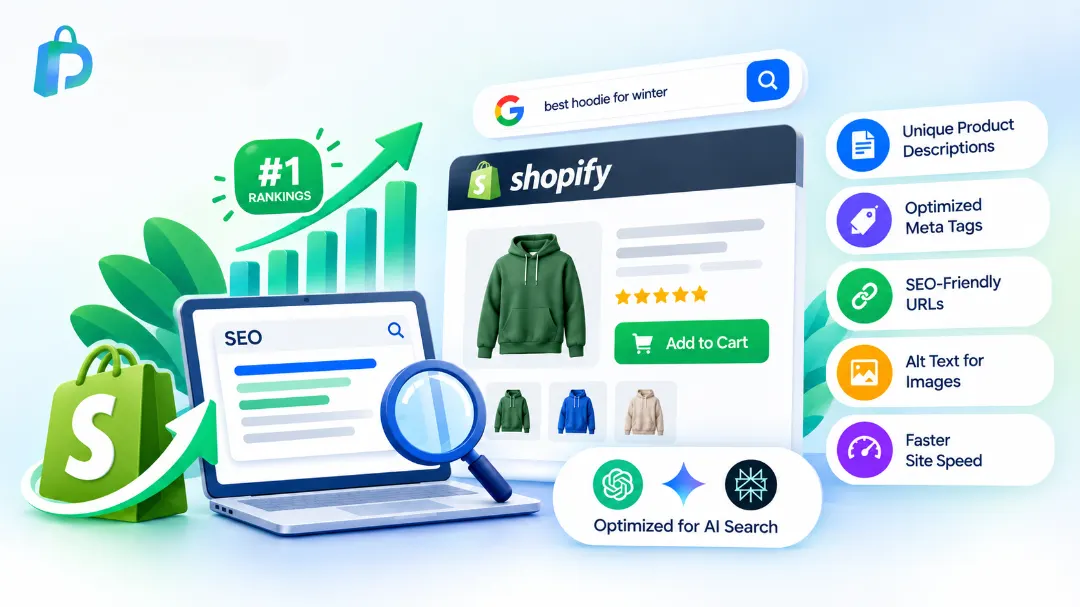
Ranking a Shopify store on Google isn’t about one big trick — it’s a set of small, consistent things done right across your whole store. Here are 10 practical Shopify SEO tips that actually move the needle in 2027.
1. Write Unique Product Descriptions for Every Product
Never copy-paste manufacturer descriptions. Duplicate content across the web (your competitors likely used the same manufacturer copy) gives Google no reason to rank you over anyone else. Every product needs its own unique, keyword-relevant description.
2. Optimize Your Title Tags and Meta Descriptions
Your page title should include your primary keyword near the front, and your meta description should be a unique, compelling 150–160 character summary — not a duplicate of your product description. This directly affects click-through rate from search results.
3. Use Descriptive URLs
Shopify auto-generates URL handles from your product title, but you can (and should) edit them to be short and keyword-clean — /products/mens-leather-jacket instead of /products/product-482910.
4. Add Alt Text to Every Image
Image alt text helps Google understand what’s in your product photos and gives you a shot at ranking in Google Image search, which sends real traffic. Be specific and descriptive: navy-merino-wool-sweater-front-view.jpg, not IMG_4582.jpg.
5. Improve Your Site Speed
Page speed is a confirmed Google ranking factor and directly affects conversion rate. Compress images, limit unnecessary apps/scripts, and choose a lightweight Shopify theme. Test your store regularly with Google PageSpeed Insights.
6. Fix Duplicate Content from Variants and Collections
Shopify can create duplicate or near-duplicate pages across product variants and collections. Use canonical tags (Shopify handles most of this automatically, but check your theme) and avoid creating near-identical collection pages targeting the same keyword.
7. Build an Internal Linking Structure
Link related products and collections to each other naturally within descriptions and blog content. This helps Google crawl your store more effectively and keeps visitors browsing longer, which improves engagement signals.
8. Publish Blog Content Targeting Buyer Questions
A blog isn’t just for brand storytelling — it’s one of the best ways to rank for long-tail, buyer-intent keywords your product pages can’t target directly (“how to choose a leather jacket size,” “best fabric for humid climates”). Link blog posts back to relevant product pages.
9. Get Listed and Reviewed
Google factors in your store’s overall trust signals. Genuine customer reviews (with schema markup so star ratings can show in search results), and being listed in relevant directories or “best of” articles, both help.
10. Optimize for AI Search, Not Just Google
A growing share of shopping searches now happen inside ChatGPT, Gemini, and Perplexity. These tools rely on the same fundamentals — clear, specific, well-structured product content — to understand and recommend what you sell. Optimizing for Google SEO largely optimizes for AI search too, as long as your content is genuinely clear and specific rather than vague or keyword-stuffed.
The Challenge- Doing This Across an Entire Catalog
Every tip above is straightforward for one product. The real difficulty is applying all of it — consistently — across 100, 500, or 2,000 products, and keeping it up as your catalog grows. This is exactly the gap Prodiify is built to close: it generates unique, SEO-optimized titles, descriptions, meta tags, and alt text across your entire Shopify catalog automatically, so no product gets left behind.
Ready to apply these tips across your whole store in minutes? Try Prodiify free on the Shopify App Store.
FAQs- About Shopify SEO Tips
1.What’s the single most important Shopify SEO tip?
Writing unique product descriptions for every product. Duplicate or manufacturer-copied content is the most common reason Shopify stores don’t rank, and it’s the highest-impact thing to fix first.
2.How long does it take to see results from Shopify SEO changes?
Typically 4–12 weeks, depending on your store’s domain age, competition, and how often Google recrawls your pages. SEO is a compounding effort, not an instant fix.
3.Does Shopify have built-in SEO tools?
Yes — Shopify lets you edit page titles, meta descriptions, URL handles, and image alt text natively. It’s a solid foundation, but doing this well across a full catalog usually needs a dedicated SEO app or process.
4.Is site speed really that important for SEO?
Yes, it’s a confirmed Google ranking factor, and it directly affects conversion rate too — slow pages lose both rankings and sales.
5.Do I need a blog for Shopify SEO to work?
Not strictly, but a blog is one of the best ways to rank for long-tail, buyer-intent keywords that product pages alone can’t target, and it strengthens your site’s overall topical relevance.
6.Should I optimize for ChatGPT and AI search separately from Google?
Not as a separate strategy — the same fundamentals (specific, clear, well-structured content) tend to help with both, so optimizing well for Google largely optimizes for AI search too.