
Shopify vs Amazon- The Product Page Gap Most Sellers Ignore
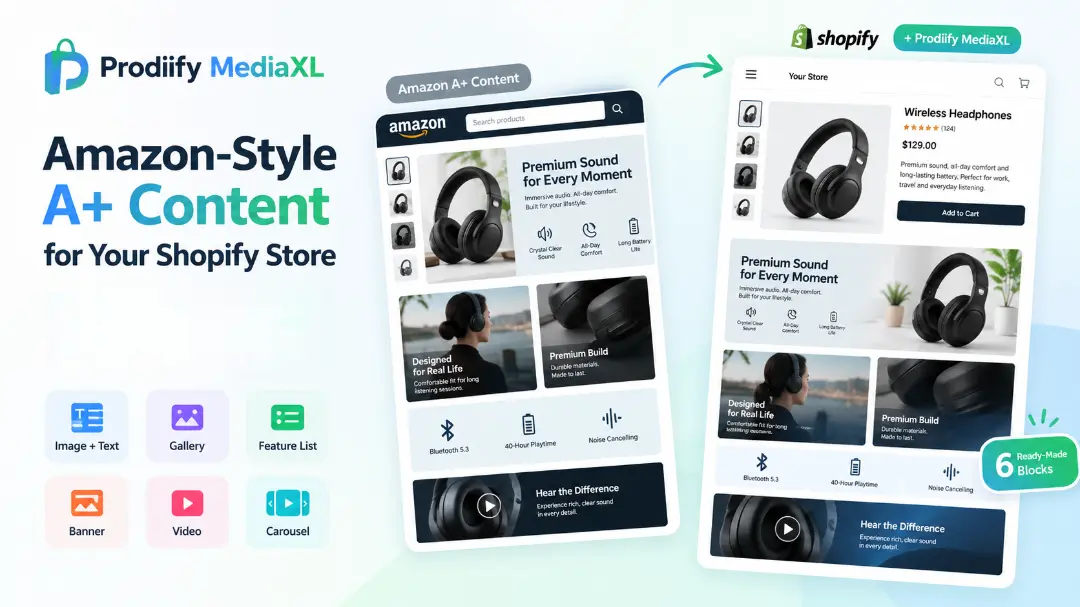
Amazon hands you a toolkit. Shopify hands you a blank canvas. Here is what that means for your sales.
When sellers weigh Shopify vs Amazon, the conversation almost always lands on fees, traffic and who owns the customer. Those matter. But there is one thing shoppers see before any of that: the product page.
Put the same product on both platforms and the contrast is immediate. One page walks you through the product like a short story. The other gives you a paragraph and a handful of photos.
What Amazon Does Well on Product Listings
Amazon gives brand-registered sellers a content system called A+ Content. It includes hero banners, feature grids, comparison charts and video modules, all built inside Seller Central. The idea is simple: structured, visual pages help people understand a product faster and feel safer buying it.
If the term is new to you, our explainer on A+ Content for Shopify is a good starting point.
What a Default Shopify Page Leaves Out
Shopify keeps its standard product page light on purpose, so it works for any kind of store. That makes launching easy, but it also means you get a gallery and a description box, with no built-in way to add modular visual sections.
This is not a sign that Shopify merchants care less about their pages. Building the richer version has simply meant hiring a developer or hunting for a workaround. If you want to compare those workarounds, we reviewed the best Amazon A+ Content alternative for Shopify.
Where the Real Difference Shows Up in Shopify vs Amazon
Here is how the three setups compare in practice:
| Amazon A+ Content | Default Shopify page | Shopify with Prodiify MediaXL | |
|---|---|---|---|
| Rich visual sections | Yes, in Seller Central | No native option | Yes, six drag-and-drop blocks |
| Access requirement | Brand Registry | None | None |
| Where content lives | Only on Amazon | Your own store | Your own store |
| Developer needed | No | Often, for custom layouts | No |
| Supports your own SEO | No | Limited | Yes, content sits on your domain |
The bottom row deserves attention. Anything you build for Amazon stays on Amazon. Content on your own store belongs to your domain, so search engines can crawl and index it. For the groundwork, see our Shopify SEO checklist and these Shopify SEO tips.
Why Your Own Store Has to Work Harder
Amazon shoppers arrive in comparison mode, with reviews and ratings sitting right beside your listing. On your own store, none of that borrowed trust exists. Your layout, images and copy have to carry the entire decision.
A stronger page helps in three ways:
- It answers questions early. Features, use cases and visuals cut down on guesswork.
- It reads quickly on a phone. Few mobile shoppers will read a wall of text.
- It is easier for AI tools to understand. Clear structure helps when shoppers ask assistants for recommendations, which we explain in Shopify AI search optimization for ChatGPT.
Good Visuals Still Need Good Copy
Rich sections work best when the words behind them are solid. If your descriptions are thin or repetitive, fix those first. Our guide to enhanced product descriptions on Shopify shows what a strong one looks like, and a Shopify product description generator can produce a first draft to refine.
Closing the Gap Without Touching Code
Prodiify MediaXL adds six ready-made blocks to any product page: Banner/Hero, Image + Text, Feature List, Gallery, Video and Carousel. You manage them from the Prodiify dashboard inside Shopify admin. No theme edits, no code, and every block is responsive by default.
It sits alongside an AI SEO app for Shopify stores, so the text that brings shoppers in and the visuals that convince them are handled in one place. You can see the full toolset at Prodiify.
A Quick Test You Can Run This Week
- Choose one product you sell on both Amazon and Shopify.
- Borrow the structure of its Amazon page: hero message, feature list, gallery.
- Rebuild it on Shopify with MediaXL blocks, rewriting the copy for your own audience.
- Publish it and compare results against similar products you have not changed.
FAQs–Shopify vs Amazon
1.Shopify vs Amazon: which has better product page tools?
Amazon has a built-in system (A+ Content) for brand-registered sellers. Shopify has no native equivalent, but apps like Prodiify MediaXL add rich content blocks without code.
2.Do I need Brand Registry to build a rich page on Shopify?
No. Brand Registry is an Amazon requirement. On Shopify you can add rich sections to any product page.
3.Does Amazon A+ Content help my own store’s SEO?
No. It only appears on Amazon. Content added on your Shopify store lives on your domain and can be indexed.
4.Can I use my Amazon content on my Shopify store?
You can borrow the structure, but rewrite the copy for your own store so the page stays original and fits your own audience.
Shopify vs Amazon Is Closer Than It Looks
Shopify and Amazon do not offer the same product page tools, but the gap is easier to close than most sellers think. You do not need a developer or a full redesign, only a better way to build the pages you already have.
Try Prodiify MediaXL free on the Shopify App Store, or explore everything at prodiify.com.